We’ve all been there. You’re waiting in a long line, sitting on a bus, or just need a five-minute mental break, and your thumb instinctively finds that familiar game icon on your phone. Maybe it’s the satisfying swap of tiles in a match-3 puzzle, the careful planning of your next city block in a builder, or the frantic tapping to keep a character from falling off a cliff.
For years, the narrative around these games has been one of guilt. “It’s a waste of time,” we whisper to ourselves. “I should be doing something more productive.”
But what if I told you that your “time-wasting” habit might actually be a secret workout for your brain? What if that quick session of Candy Crush or Monument Valley is doing more for your cognitive fitness than you realize?
Stick with me, because we’re about to dive into the fascinating science that explains how the right kind of mobile play can sharpen your focus and strengthen your memory. This isn’t about justifying a 10-hour binge; it’s about understanding how to turn your playtime into smart, brain-boosting time.
It’s Not Just Fun and Games: Your Brain on Mobile Play
Let’s get one thing straight from the start: not all games are created equal. Spending your day in a hyper-casual, ad-filled vortex might not yield the same benefits as engaging with more thoughtful titles. The key lies in the cognitive demands a game places on you.
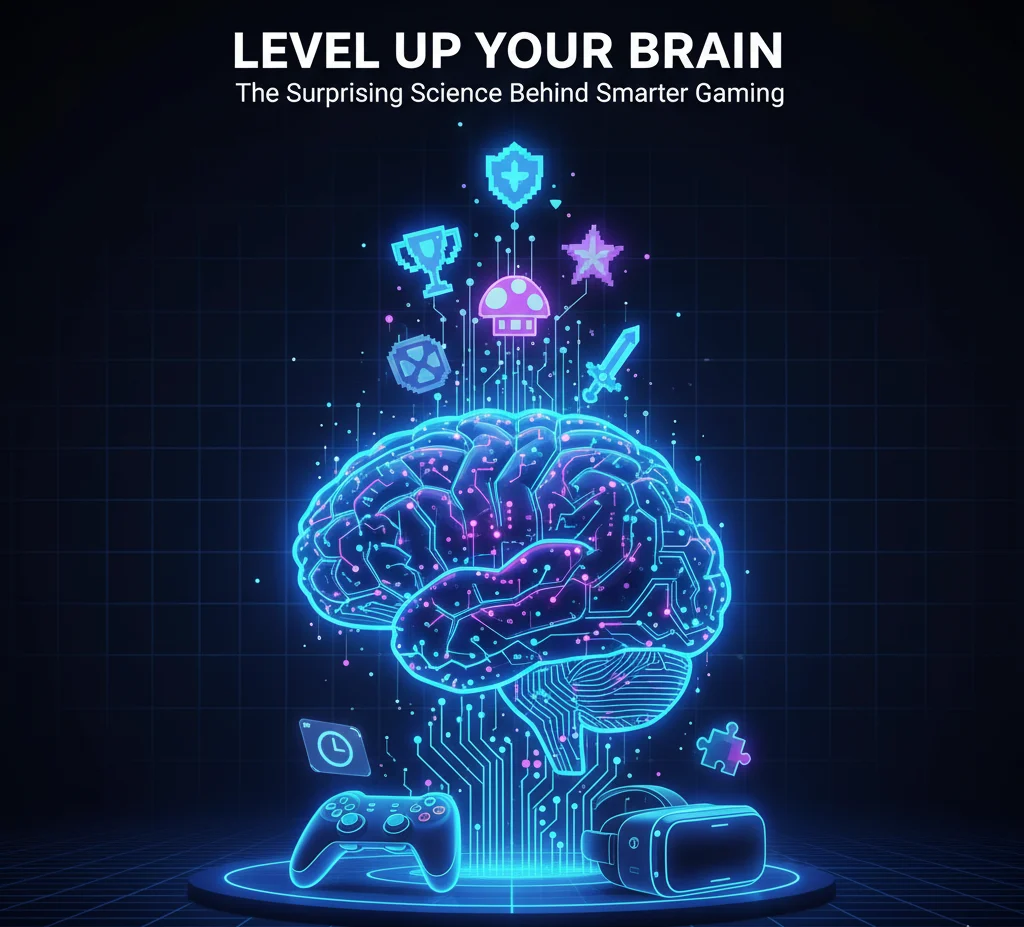
When you play a game that requires strategy, quick decision-making, or spatial reasoning, your brain isn’t just passively receiving information. It’s lighting up like a pinball machine. Neuroscientists using fMRI scanners have observed increased activity in several critical brain regions during gameplay, including:
-
The Prefrontal Cortex: This is your brain’s CEO. It handles complex cognitive behavior, decision-making, and planning. When you’re figuring out the optimal move in a strategy game, this is the part of you that’s working overtime.
-
The Hippocampus: This is your memory’s central filing cabinet. It’s crucial for forming new memories and navigating spatial environments. Games that require you to remember level layouts or complex rules give this region a healthy workout.
Think of it like this: going for a run strengthens your heart and legs. Playing a cognitively engaging game is like a treadmill session for your mind. It’s building mental muscle.
The Focus Gym: How Games Train Your Attention
In a world of endless notifications and multitasking, our attention spans are under constant assault. The ability to focus on a single task—known as sustained attention—is becoming a superpower. Believe it or not, mobile games can be a powerful training ground for it.
How it works: Many games are built on a loop of “action-reward.” You focus, you perform a task, you get a reward (points, a new level, a satisfying sound). This loop directly engages your brain’s dopamine system, not just for the pleasure, but to reinforce the behavior of paying attention.
Take a game like Two Dots. You have a specific objective, like connecting a certain number of dots of the same color. For those 60 seconds, your world narrows to that board. You’re not thinking about your inbox or what to make for dinner. You are fully immersed. This state of “flow,” a term coined by psychologist Mihaly Csikszmihalyi, is the holy grail of focus. It’s that feeling of being completely absorbed in an activity, where time just flies by.
Games force you into this state by providing clear goals and immediate feedback. If your focus wavers, you lose. It’s that simple. This constant practice in maintaining concentration can, over time, strengthen your ability to focus on tasks outside the game. It’s like a daily meditation session, but with power-ups and a leaderboard.
Memory Lane is a Puzzle Path: Boosting Recall One Level at a Time
If focus is one side of the coin, memory is the other. And our memory isn’t a single, monolithic thing. We have different types, and games can target them in unique ways.
Working Memory: Your Mental Scratchpad
This is the brain’s Post-It note. It’s the information you hold in your head for a short period to complete a task. Remembering a phone number long enough to dial it? That’s working memory.
Many puzzle games are a brutal workout for this system. Consider Brain Dots or any game where you have to remember the layout of previous moves. You have to keep the rules, your objective, and the consequences of your last action all in your head at once. A 2015 study from the University of California, Irvine, found that playing complex 3D games improved participants’ performance on memory tests that relied heavily on the hippocampus. It’s like doing reps for your mental scratchpad, making it more reliable and spacious.
Spatial Memory: Mapping the World in Your Mind
This is your ability to remember the layout of your environment. Where did you park your car? How do you get to your friend’s apartment without GPS? This is spatial memory at work.
Games are fantastic for this. Even a simple game like Subway Surfers or Temple Run requires you to quickly assess the upcoming path and remember the positions of obstacles. More complex games like Monument Valley or The Room series are entire playgrounds for spatial reasoning. You’re constantly rotating objects, navigating impossible architecture, and building a mental 3D map of the world. This kind of practice is directly transferable to the real world, potentially making you better at navigation and remembering where you left your keys.
The Strategy for Smart Play: It’s All About Balance
Before you run off to tell your partner that your Clash of Clans raid is “important research,” let’s talk about the golden rule: intentionality and balance.
Mindlessly grinding for hours is unlikely to provide much benefit and could lead to the negative effects we often hear about, like eye strain or neglecting responsibilities. The goal is mindful play.
Here’s how to make your gaming a net positive for your brain:
-
Choose Quality Over Quantity: Opt for games that require genuine thought. Puzzle games, strategy titles, brain trainers, and complex arcade games are your best bet. If a game feels like it’s on autopilot, it probably is for your brain, too.
-
Set a Time Limit: Treat your gaming session like a workout. Twenty to thirty minutes of focused play can be incredibly beneficial. Use a timer if you have to. This prevents the session from bleeding into time reserved for other important activities.
-
Embrace the Challenge: Don’t be afraid to fail! Getting stuck on a level is where the real learning happens. Your brain is working hard to find a new solution. If a game becomes too easy, it’s time to move up a difficulty level or try something new.
-
Mix It Up: Just as a balanced workout routine targets different muscle groups, playing a variety of games challenges different cognitive skills. One day, play a logic puzzle. The next, try a fast-paced reaction game. This “cross-training” ensures your whole brain gets a workout.
The Final Boss: Putting It All Together
So, the next time you feel a twinge of guilt for diving into your favorite mobile game, remember this: you’re not just killing time. If you’re playing with purpose, you are actively engaging in an activity that can enhance your ability to concentrate, solve problems, and hold onto memories.
Your phone is more than a social media portal or a messaging device; it’s a pocket-sized cognitive gym. The science is clear—targeted play has real, measurable benefits for your mental faculties.
Now, if you’ll excuse me, I have a particularly tricky Lara Croft GO level to solve. My hippocampus is calling.
Frequently Asked Questions: Gaming for a Sharper Mind
You’ve got questions, I’ve got answers. Let’s tackle some of the most common curiosities about turning your playtime into a brain-boosting session.
So, does this mean I can tell my boss I’m “training my brain” when I play at my desk?
While the science is compelling, context is everything. The key is intentional, focused play for a limited time as a mental break, not a distraction from your work tasks. Think of it like a coffee break for your mind. A 5-10 minute session on a puzzle game can help reset your focus, but hours of play during a project deadline probably won’t win you any employee-of-the-month awards. It’s about smart integration, not substitution.
Are some types of games better for my brain than others?
Absolutely, and this is a great question. It’s like asking if all food is equally nutritious. Games that actively challenge you are the way to go. Look for titles that require:
-
Planning and Strategy: Games where you have to think several moves ahead.
-
Problem-Solving: Puzzle games that make you find patterns, sequence solutions, or think logically (Monument Valley, The Room series).
-
Quick Decision-Making: Fast-paced games that require you to process information and react swiftly without just mindless tapping.
Generally, if a game feels like it’s on autopilot, your brain probably is, too.
I’ve played a lot of games, but I don’t feel like my memory is superhuman. Why not?
That’s a really honest and common feeling. The benefits we’re talking about are often subtle and related to specific cognitive skills, not necessarily giving you a perfect photographic memory. The improvement is in the process—your brain gets better at holding information temporarily (working memory) or navigating mental maps (spatial memory). It’s less about remembering your friend’s birthday and more about being able to hold multiple pieces of a work project in your head at once. The transfer happens with consistent practice, just like going to the gym doesn’t make you a bodybuilder after one session.
How much time should I actually spend playing to see a benefit?
More isn’t always better. Research into cognitive training often uses short, focused sessions. Think quality over quantity. Aim for 15-30 minutes of engaged play most days, rather than a multi-hour marathon on the weekend. This mirrors the “little and often” approach that’s effective for learning most new skills. The goal is to end your session feeling mentally invigorated, not drained or zoned out.
Aren’t “brain training” games the only ones scientifically proven to work?
This is a classic debate! While dedicated brain training apps are designed specifically for cognitive improvement, they don’t have a monopoly on the benefits. The fantastic thing about many mainstream mobile games is that they train your brain incidentally. You’re focused on beating the level or solving the puzzle, and the cognitive workout is a happy side effect. This can often feel more engaging and sustainable than a formal “brain test.” So, while brain training games have their place, a well-designed puzzle or strategy game can be just as effective, and often a lot more fun.